
This week (March 11-17, 2019), within the global #OpenWeek week, different Open Data events have been held in Panama. Today was perhaps the main event of the week, called “Open Panama”, organized by ANTAI within the CAIC (Panama-Korea Information Access Center), where the ITI (Institute of Technology and Information) also operates, in the City of Knowledge.
The truth is that I was impressed by the progress that is being made in Panama in terms of opening data in the government sector, all promoted by ANTAI and also supported by organizations such as the AIG, OAS and The Trust for the Americas (part of the OAS).
After the main event, the group was separated into three working tables, where one of the three tables was related to the Open Data Guide and the Open Data Portal. The guide, as a base, is very well prepared, as is the Portal.
When starting the process, some questions were discussed. One of the participants at the table spoke about a problem of granularity of the data that has been published, to which I complemented with my personal experience and mentioned that we must seek to make the data completely open, instead.
The response of one of the other participants was to describe this as a “utopia” and that in Open Data we should display the processed _information, to which I double-checked whether it was in an Open Data or Open Information event.
#.Data, Information and Knowledge
From here a debate arose that I think many are unaware of and it is important to clarify.
The entire Data generation process, like any other data exploitation and exploration process, has as its goal the generation of knowledge.
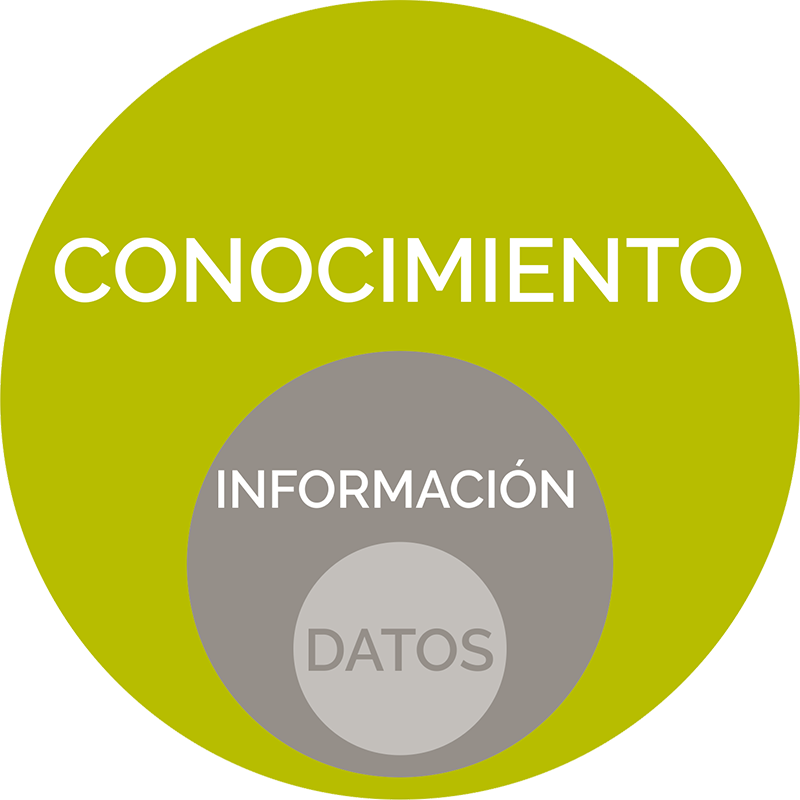
The generation and management of knowledge are new terms within the branches of technology, which is why we have gone from talking about “Information Technologies” to “Knowledge Technologies”.
In fact, I studied “Knowledge Technologies”, to clarify that it is not only about the exploitation of Data but also about its interpretation in much more complete stages.
That is why we actually have three important terms:
- Fact: It is the smallest, raw, unprocessed unit. They are the minimum semantic and primary unit. By themselves, they should be irrelevant.
- Information: These are data with meaning acquired from the incorporation of relevance, purpose and context.
- Knowledge: It is using this information, mixing it with experiences and know-how for interpretation and decision making.
That is to say:
- if we have lists of medications and their quantities in all social security pharmacies, displayed sequentially (data),
- but then through that data we generate reports or statistics (information),
- that they complement us to decide in which social security pharmacies we have the most incidents of lack of medication (knowledge).
#.The reports are fine, but we require the source of them
Rather than requiring statistics, reports, information broken down and categorized in different ways, it is more useful for all of us that the source of them be published.
Can you imagine how many possible reports could be generated from the same data source? That is why, wouldn’t it be more appropriate to offer raw data, so that people can decide how to contextualize said data for their own needs?
In other words, and through an analogy, just as I said already on Twitter and on other social networks:
Analogically. Instead of everything being delivered cooked and on a plate, ready to eat (information), preferably deliver the ingredients so that we can decide what we want to eat based on everything we could cook (data). I want to be a data chef.
I think this is of utmost importance and it is important, for any other future process, to understand and differentiate why the opening of data and not information is so useful and necessary.