
Anyone who knows me knows that I usually try to avoid meetings as much as possible.
A few days ago, reading Twitter, I found this post from my friend, Arles, to which I responded with several questions that I always ask myself when I’m in one of those meetings where we don’t know how we got there:
Y cuántas han sido productivas? Cuántas pudieron ser un correo? En cuántas hubo gente innecesaria? Cuántas duraron más de la cuenta? Cuántas no tenían una agenda? Aquí en Panamá se abusa de las reuniones, aún no me acostumbro como se trabaja aquí, es anti Lean todo.
— Demóstenes García G. (@demogar) June 20, 2018
Since 2014 I have been working for IFARHU, a government organization. The number of meetings in this position is significantly higher than the number of meetings I previously attended. Little by little I have realized that this is not mainly due to the responsibilities I have, but rather to the perception that people have about the meetings.
A few years ago I was invited to a meeting to plan a meeting, I immediately remembered the Dilbert cartoon (as a Software Developer, I obviously love Dilbert):
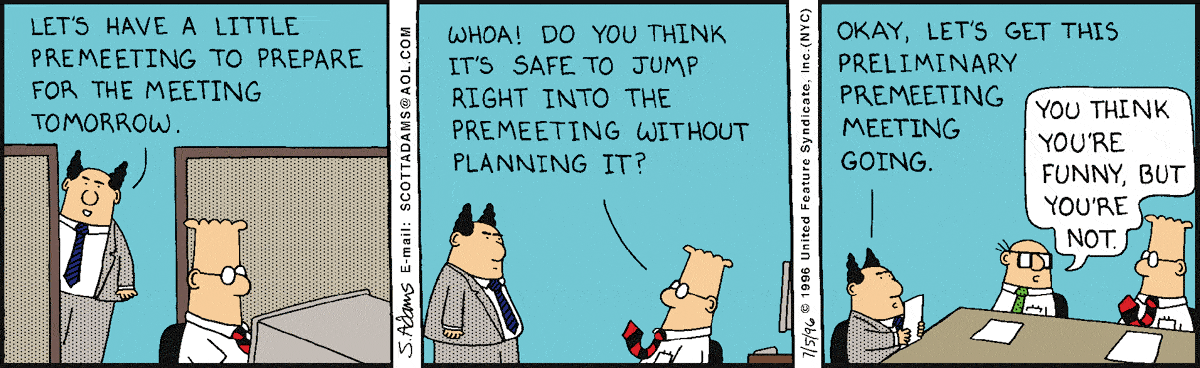
That was a time when I had to rethink my participation in meetings and the need for bureaucratic meetings. In addition, establishing a schedule for meetings, something that I have noticed is quite non-existent in our Panamanian work ecosystem.
#.My rules for meetings
I have not invented these rules, far from it. I did a retrospective of what I noticed was regular in the meetings I participated in previously, about which I very rarely had complaints.
These rules only apply to meetings that emanate from my work team. Ideally we ask for some details in advance to know if the meetings are really necessary.
#.1. There must be someone in charge of the meeting
There should always be someone in charge of the meeting, who will lead the meeting and who should prepare, in advance, the meeting agenda (rule #2).
#.2. There must be an agenda established and sent in advance
The person in charge must prepare a specific agenda of the topics that will be discussed at the meeting. This agenda should be prepared in advance and sent to people in advance.
These agendas define the scope of the meeting. Any conversation outside the scope of the meeting is ruled out within the meeting, including personal topics or topics unrelated to the meeting in question.
This agenda must be clear:
- The objectives of the meeting
- Recommended meeting participants
- Any information needed to bring to the meeting
- The date and place of the meeting
- The start time of the meeting
- The end time of the meetingIf there are points that require the participation of a specific person or team, they are noted on the meeting agenda so that the person can prepare for the meeting and avoid rambling.
It is also important that the agenda defines the purpose of the meeting, of which we can define two: It is a meeting to discuss (evaluate) a point or it is a meeting to decide a point.
We should think of meetings as short projects: in the end, they are temporary (start-finish) efforts, carried out to create a unique result. Does the definition sound familiar to you?
#.3. Meetings, whenever possible, should be scheduled in advance and require a single central topic
Usually the plans are weekly. Meeting requested in the same week is probably a meeting rejected, with emphasis on meetings that require information in advance.
This allows everyone to master the meeting agenda and be able to prepare with basics for the meetings.
Meetings should discuss a single topic. Different topics are discussed in different meetings.
#.4. Meeting times are respected (and should be as short as possible). Follow-up meetings are held on the same days, at the same times and for the same time block.
This, and with the support of having a clear agenda, keeps meetings to the point. The ceremonies in our frameworks (such as Scrum ceremonies) facilitate some of these processes.
If the meeting was scheduled for 1 hour, the start time and end time of the meeting must be respected. If the people who are meant to participate arrive late to the meeting, it is decided whether or not the meeting will be held immediately. If it is carried out, the end time is maintained.
#.5. Cell phones, if possible, outside the meeting or in the center of the table
They are a factor of deconcentration that, usually, do not contribute anything positive and only lead to people not following the thread of the conversation.
By making meetings last the shortest amount of time, it is common for people to stay focused on the meeting since the points are attacked directly.
#.6. Only the required people are invited
How many times have we been in a meeting where we didn’t say a single word? This is a method that Elon Musk, the man behind SpaceX, Tesla Motors, Hyperloop, among others, has made public on several occasions.
- If someone has partial and not complete participation, they can leave the meeting once their participation ends.
- Avoid having people who do not participate in the meeting. If someone is only going to attend the meeting, do not participate. Jeff Bezos (Amazon) refers in these terms to something called “The Two Pizza Rule” to keep meetings as small as possible. Basically it means that we should not have meetings with more people than we can feed with two boxes of pizza.
#.7. A minute must be made, with clear follow-up points
We are in the meeting for something, right? The person in charge must prepare meeting minutes, who must deliver these minutes as soon as possible.
This minute may have elements such as:
- Decisions made at the meeting
- The action items with their direct manager. This is what Steve Jobs called DRI (Directly Responsible Individual).
- Next steps
- Results achieved in the meeting
- Improvements for future meetings
- Elements that were left undiscussed in this meeting
For the ceremonies of some frameworks this procedure is ignored, since the ceremonies already have an output (such as updating the boards).
#.8. (Bonus) Can this meeting be replaced by an email, call or video conference?
This is a Bonus to the rules and is often useless. I have come across meetings to request support or information that are delayed (due to lack of availability on the agenda) by even weeks.
Arriving at the meeting to discover that it is something that can be attended to in 5 minutes and that did not require physical presence is not funny at all.
If what will be addressed in the meeting can be addressed by a call, email or video conference, then let’s opt for this route; In the end, we save time and resolve faster.
#.Conclusions
These rules have served a lot to keep meetings short, not so frequent, to the point and above all: productive. Usually meetings between teams do not last more than 20 minutes.
As a developer (known for being practical) I know that there is nothing more frustrating than walking into a meeting where you shouldn’t be and having it last for hours while people talk about their pets or their trip to the beach over the weekend.
Likewise, this is not to discredit the need for meetings. Meetings are necessary most of the time. The intention of these rules is so that the meetings that are necessary are carried out in the most productive way possible and those that are not, are not held.
What would you contribute to these meeting rules?